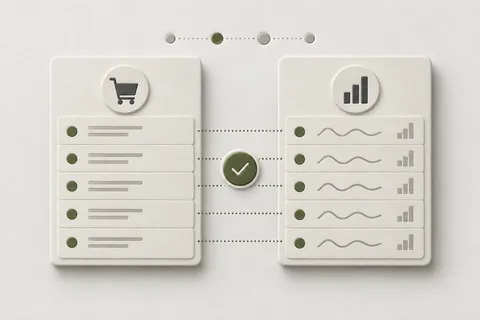
My own measurement pipeline
an order and ad-spend warehouse, plus typed profit-reporting code carrying cost coverage, freshness and missing-data states. Current production availability of the reporting fields has not been re-verified.
Data, reconciliation & reportingOwn product
I join orders, ad spend and observed costs into a reporting model your team can check, with missing costs and unmatched orders kept visible.
Sounds familiar?
How I solve it
I build a reporting warehouse that joins order records, ad spend, refunds and the costs you can actually supply. I agree the financial definitions with your team, preserve source and revision information, and expose the coverage behind each figure. Platform claims stay separate from observed economics. Unknown costs, stale imports and unassigned orders are part of the report.
The starting contract defines order margin as gross revenue minus refunds and COGS. Margin ROAS is that margin minus shipping, divided by ad spend. Remaining contribution subtracts shipping and ad spend from order margin. I keep revenue ROAS separately labelled and agree the tax, fee and overhead scope with your team. Missing required inputs make the affected measure incomplete; zero spend does not produce an invented ratio.
The process
6 steps. Scope and a fixed price are agreed before the first one.
Agree the reporting currency, date basis and treatment of refunds, tax, fees and shipping.
Inventory the supported order, ad-spend and cost sources and their update behaviour.
Import records with stable keys, revisions and freshness checks.
Join at the agreed grain and retain unmatched orders, spend and missing costs.
Define each metric explicitly and test revised orders, refunds, missing costs and zero spend.
Reconcile totals with the source exports and hand over the report and refresh runbook.
Handover
Built with
Proof
Own product Built and run by me, in production.
Before → after
In my own product engineering, separate order and ad-spend facts are represented in a warehouse, and the profit-reporting contract distinguishes measured, partial and unavailable values. The code also carries cost coverage and freshness. That is the backing for the method; I have not re-verified the current live availability of those report fields in this session.
My own measurement pipeline
an order and ad-spend warehouse, plus typed profit-reporting code carrying cost coverage, freshness and missing-data states. Current production availability of the reporting fields has not been re-verified.
What you can look at
The proposed acceptance pack includes synthetic order rows, a refund revision and a cost-coverage table. It shows complete costs, missing shipping and zero ad spend as distinct states, alongside a reconciliation to the synthetic source totals. It uses no client store, campaign or order identifiers.
Own-product engineering, not a client profit result. Code and data contracts were inspected; live reporting availability was not re-verified. The report covers agreed contribution measures, not a complete company profit-and-loss statement.
Price and timeline
A Custom Engineering Project starts from USD 1,500. I quote the sources, import schedules, definitions and acceptance checks in writing. Getting a cost export or confirming its meaning is a milestone, not an assumption hidden in the delivery date.
QuoteFixed before work starts

A note from Daniilbefore you decide
If your existing finance and marketing reports already reconcile with documented formulas and visible cost gaps, keep them. If nobody can supply reliable cost data, start with the cost records. A warehouse cannot recover a margin input that the business never recorded.
— Daniil
Questions
It stays unknown. The report shows cost coverage and which values are incomplete, rather than turning missing costs into profit.
No. I keep platform-reported claims separate from observed order economics and document the join rules. Unmatched orders and spend remain visible.

The first answer is free, within one working day. Or write directly: next@taskfordaniel.com