Club and school kit retailer
collection scheduling from metafield dates, a storefront countdown and a run history, live on the client's own app subdomain from 2026-07-22; 25 commits over April–July 2026.
Custom Shopify apps, checkout & paymentsClient work
Scheduled collection drops that open and close on dates, with a storefront countdown, built as a Shopify app.
Sounds familiar?
How I solve it
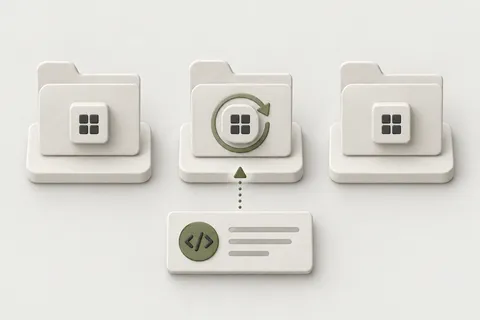
I build a Shopify app that opens and closes collections on schedule from metafield dates. There is a deliberate line between a real availability change and a display-only notice, so a “closing” notice does not accidentally remove products. A storefront countdown theme extension shows the window, and its wording is editable per collection. Every change is written to a run history, so when a window closed is something you can prove rather than remember. Where the build needs it, the same schedule can carry to a checkout extension, so the storefront and the checkout tell one story.
The process
6 steps. Scope and a fixed price are agreed before the first one.
as collection metafields (start and end dates).
that reads the dates and publishes or unpublishes through the Admin API.
with a managed availability mode.
as a theme app extension, mobile-safe and clear of banners and widgets.
with a checkout schedule extension.
in a run history, so a closed window is auditable.
Handover
Built with
Proof
Client work Done for real clients. Client details are anonymised.
Before → after
Collections that had to be opened and closed by hand now change from metafield dates, with a storefront countdown. The app went live on the client’s own app subdomain on 2026-07-22, built in 25 commits (2026-04-21 → 2026-07-28).
Club and school kit retailer
collection scheduling from metafield dates, a storefront countdown and a run history, live on the client's own app subdomain from 2026-07-22; 25 commits over April–July 2026.
The App Store edition of my collection scheduler
standard Shopify OAuth distribution, a paid plan with a trial, GDPR compliance webhooks and a timing-safe cron endpoint. App Store P0 items are still open, so there are no merchants yet; it derives from code a client paid for, so I am not naming it until the rights decision is settled.
[He] made the perfect app for us and is brilliant to work with.
What you can look at
A redrawn timeline — metafield dates → availability change → storefront countdown → checkout notice — on synthetic data, plus a sample run-history entry.
Client details anonymised. Figures come from delivery records, 2026.
Price and timeline
A bounded scheduling setup is a Focused Fix from USD 450. A full app with a storefront countdown and a checkout extension is a Custom Engineering Project from USD 1,500, scoped and quoted in writing. Discussing the task is free.
QuoteFixed before work starts

A note from Daniilbefore you decide
If a drop happens once, a manual publish the night before is fine and free. If you do not need a countdown or a checkout notice, a plain metafield automation may be more than you need.
— Daniil
Questions
No. It changes availability, reversibly. The products stay; the window opens and closes on schedule.
A run history records each change, so a missed window is visible. The job is per-shop and logged.
Yes. The wording is editable in the app, per collection, and the storefront shows it through a theme extension.
The client line is in production. The App Store edition is deployed but not submitted, and its P0 items are still open.
No.

The first answer is free, within one working day. Or write directly: next@taskfordaniel.com