
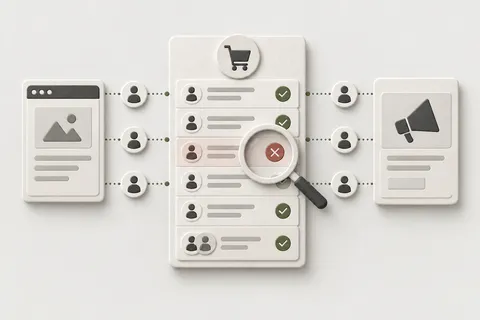

I want an AI search dashboard to answer two separate questions: where is the store visible, and which recorded visits lead to purchases?
Google and Bing supply visibility signals. GA4 supplies visits and attributed revenue. Putting them beside each other helps me investigate a page. It does not prove which AI answer produced a sale.
Google: impressions and an export
Google’s Search Central announcement now records worldwide rollout on 31 August 2026. The dedicated Search report covers impressions in AI Overviews and AI Mode. It also has a separate counterpart for Discover.
The Search help describes page, country, date and device dimensions. Page data is generally assigned to canonical URLs; dates use Pacific Time. Its download button exports chart and table data. Unavailable values displayed as a tilde or dash become zeros in the export.
I preserve that limitation in the dashboard. An exported zero is not always proof of zero visibility.
The page does not document API access or scheduled exports. My starting plan is a manual download at an agreed cadence, followed by an import. I do not sell that as a fully automated pipeline.
AI activity also appears in the main Performance report. Its aggregate Web clicks cannot be treated as the isolated numerator for an AI-only click-through rate.
GA4: sessions and attributed purchases
Google’s release notes date the AI Assistant channel to 13 May 2026. Recognized assistant referrers receive the medium ai-assistant and campaign (ai-assistant). The current channel definitions put Google AI Overviews and AI Mode in Organic Search.
I show session-scoped channel data with landing pages and purchases attributed to those sessions. The AI referral guide explains the related reporting work.
I inspect the actual source data before changing a custom channel group. Google’s example assistant names are not a complete membership list. Missing referrers can obscure origin, and Organic Search cannot be relabelled wholesale as AI.
Bing: citations, not visits
Bing AI Performance covers citations across Microsoft Copilot, Bing AI summaries and selected partner experiences. Its page view identifies cited URLs; grounding queries describe aggregated retrieval context.
The documented CSV and Excel downloads include page citations, query citation counts and time series. I use a page-level citation column. I do not call it Microsoft referral traffic, ranking or conversion attribution.
Compare by page, without inventing a journey
Comparison table — scroll horizontally to see all columns
| Column | What I use it for |
|---|---|
| GSC AI impressions | Google visibility |
| Bing page citations | Microsoft AI visibility |
| GA4 AI Assistant sessions | Recorded assistant visits |
| GA4 Organic Search sessions | Search visits, including Google AI traffic |
| Purchases and revenue attributed to those sessions | GA4’s measured commercial result |
I map GSC canonical pages and Bing cited URLs to GA4 landing pages. I preserve query parameters that change content and document every mapping. I align reporting periods and note time-zone differences.
A page with rising citations and flat revenue needs investigation. It is not proof of either success or failure. The dashboard cannot join a specific impression or citation to a specific buyer.
How I can help
I can build the comparison under GA4 consulting, with source freshness and missing data visible. If tracking is already reliable, I can quote the dashboard. If purchases or channel attribution are uncertain, we agree a diagnostic engagement first.