US fertility-education brand
a read-only Kit (ConvertKit) API v4 audit of forms, tags, sequences and custom fields that reported gaps, then site captures wired to Kit with a fallback syncing Shopify orders to Kit.
Integrations, MCP & workflow automationClient work
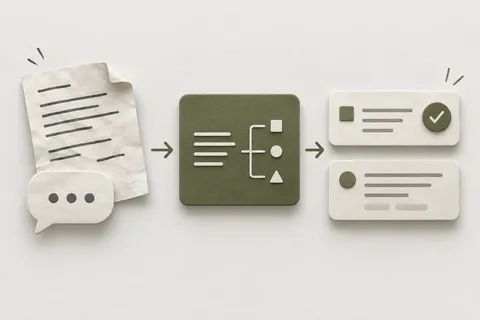
Direct API integrations between your store, CRM, email and payments — with idempotency, retries and an audit trail, instead of a chain of automation steps.
Sounds familiar?
How I solve it
I build the integrations directly against the API of each system — your store, CRM, email and payments — and I take the middle tool out of the path. A direct call is idempotent, retried on a schedule, and logged, so a repeated event updates a record instead of creating a second one, and a failed call is visible rather than silent. Where a tool genuinely has no usable interface, I say that during scoping, not after the invoice.
The habit behind this is old: one of my early automation clients was a job where I stayed on and helped their other contractor finish the work. Direct integrations are the same job with fewer moving parts.
The process
6 steps. Scope and a fixed price are agreed before the first one.
Map the current chain: which trigger calls which tool, and what breaks when one step fails.
Find the direct path: the provider's own API or webhook for each hop, and where none exists.
Make it idempotent: stable keys so a replay or a retry updates a record instead of duplicating it.
Add retries and a visible failure: a queue, a dead-letter path and an alert on a stuck item.
Keep an audit trail: what was sent, to which system, when, and with what result.
Hand over the integration, the runbook and the failure modes.
Handover
Built with
Proof
Client work Done for real clients. Client details are anonymised.
Before → after
Before, one booking could write three rows because three writers raced on the same record; after an in-process mutex, one booking writes one row. That fix came from the US telehealth build, closed on 2026-08-20.
US fertility-education brand
a read-only Kit (ConvertKit) API v4 audit of forms, tags, sequences and custom fields that reported gaps, then site captures wired to Kit with a fallback syncing Shopify orders to Kit.
US telehealth practice
Stripe checkout webhooks feeding a Google Sheet and a scheduled Google Ads offline import, plus a booking webhook with HMAC verification and an in-process mutex after a real race.
CRM and marketing-automation integrations on Upwork
ActiveCampaign, Customer.io, Salesforce, HubSpot, Zapier, and Google Apps Script parsing and reconciliation.
[He] did more than we asked him to do and even helped a third-party contractor of ours with some work without charging.
What you can look at
A redrawn integration map — store → direct API → CRM/email → payments — with the idempotency key and the retry-and-alert path marked, on synthetic data. Beside it, a short failure table: what happens at each hop when a provider is down.
Client details anonymised. Figures read from the engagement records. I am the founder of Fixel Pixel.
Price and timeline
A single bounded integration is a Focused Fix, quoted before it starts, from USD 450. A rebuild across several systems is a Custom Engineering Project, quoted in writing from USD 1,500. Which one it is gets decided by the map of the current chain, not by preference.
QuoteFixed before work starts

A note from Daniilbefore you decide
If two apps already talk to each other natively and the volume is low, a native connector is cheaper than a custom integration. This pays off when the chain is long, the volume is high, or a silent failure costs real money. If only one step needs moving, that can be a small Focused Fix; a full direct-integration rebuild is a larger project, and I will tell you which one you actually need.
— Daniil
Questions
No. A connector is fine for a simple, low-volume step. It stops being fine when the business depends on it and a failure is invisible.
Sometimes the honest answer is that it cannot be integrated directly, and the job is to route around it. That gets said during scoping, before any quote.
Every handoff carries a stable key, so a retry or a replay updates the existing record instead of creating a new one. Duplication is a design decision, not bad luck.
The integration fails visibly and retries, rather than failing silently. I hand over the runbook so your team can see which hop broke and what to do.
Yes. The point is to move the critical paths — orders, payments, CRM writes — to direct calls, and leave low-stakes steps wherever they already work.

The first answer is free, within one working day. Or write directly: next@taskfordaniel.com